Sarawak, Malaysia’s largest state, faces a unique geographical challenge with its vast, dispersed rural population.
Its digital transformation, outlined in the Post-COVID-19 Development Strategy 2030, is not merely an economic goal but a necessity for social inclusion.
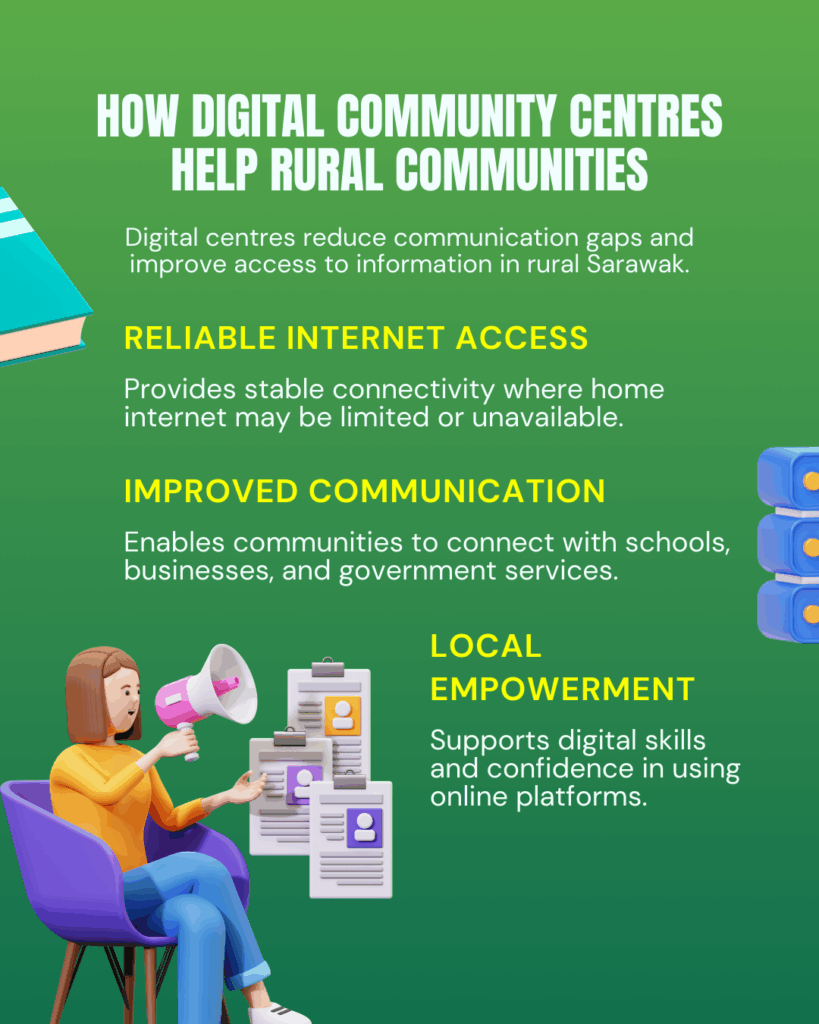
The strategy rests on three pillars: NADI (National Information Dissemination) centres as community access points, the SMART600 telecommunications project to eliminate connectivity dead zones, and the digitalisation of government services via platforms like SarawakPass.
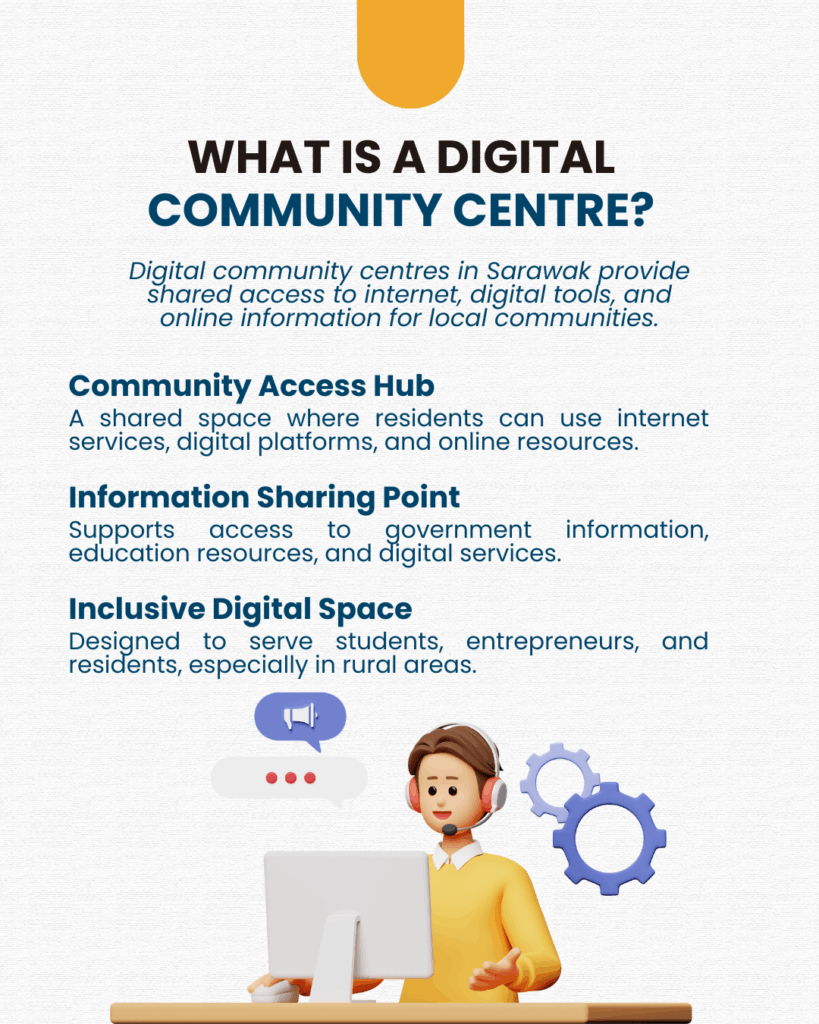
The role of NADI centres has evolved from basic internet points to hubs for digital skills and e-commerce.
With 156 centres state-wide, they recorded 1.4 million participations in 2025.
However, a critical weakness is revealed by the fact that 60% of users are students reliant on these centres for education.
This highlights a core issue: while geographical access to connectivity points has been solved, universal household connectivity remains unattainable for many, making public centres an inadequate substitute.
The SMART600 project represents a sophisticated public-private partnership to overcome market failure in rural telecoms.
By having the state cover capital costs for tower construction and private operators manage operational costs, 587 towers were completed by July 2025.
The use of Multi-Operator Core Network (MOCN) technology allows multiple providers to share infrastructure, fostering competition. Yet, challenges persist.
Service quality varies, and while 4G expands, Sarawak lags in the global 5G rollout.
This divide has significant implications for future applications in AI, telemedicine, and IoT, suggesting that the current strategy, while effective for baseline connectivity, may not meet future demands for ultra-low latency and high bandwidth.
Sarawak’s digital governance is shifting from basic digitalisation to a data-driven, AI-integrated model.
SarawakPass, a unified digital identity platform, serves as the foundation. By early 2026, over 62% of government services were digitalised.
Its true innovation is in enabling proactive governance, as seen with iSarawakCare.
By integrating data across agencies, the platform proactively identifies eligible citizens for welfare assistance, transitioning from a pull-based to a push-based service model.
The Sarawak AI Centre represents a significant leap, moving from policy to implementation with a RM5 million allocation.
Its projects are ambitious:
– DeepSight: A population health management platform.
– AI Diagnostic Tools: Developed with the Ministry of Health to bring specialist diagnostics to rural areas via smartphones, directly addressing urban-rural healthcare inequality.
– Keteq AI: A gallium nitride-based semiconductor platform developed by SMD Semiconductor, positioning Sarawak as a creator of deep-tech hardware.
However, there a growing bifurcation in Sarawak’s digital strategy.
One track is a high-tech, capital-intensive push into AI and semiconductors aimed at creating a regional tech hub.
The other is a social-welfare-focused effort to provide basic connectivity to rural communities.
The risk is that these tracks operate in silos, with the benefits of advanced technology accruing to urban elites while rural areas remain dependent on NADI centres for basic access.
The true measure of the AI Centre’s success will be its impact on remote and underserved populations, not just patents filed.
The digital transformation is reshaping economic practices at the grassroots level.
The digital wallet platform, S Pay Global, has seen exponential growth, serving 1.6 million users and 95,000 merchants by early 2026.
The government’s plan to evolve it into a full-fledged digital bank is critical for financial inclusion, enabling rural traders without formal bank accounts to participate in the digital economy.
However, the success of this cashless agenda is fundamentally tied to the reliability of the connectivity infrastructure provided by SMART600.
The digital economy’s impact on micro, small, and medium enterprises is quantifiable.
The Sarawak Digital Mall initiative, in partnership with TikTok Shop, generated nearly RM12 million in sales in 2025, training over 350 local entrepreneurs.
This demonstrates that digital platforms, when combined with targeted training and support, can help rural entrepreneurs bypass geographical constraints.
This success underscores the importance of pairing infrastructure investment with human capacity development.
Despite progress, three persistent challenges threaten the long-term success of the digital transformation:
- The Gap Between Access and Meaningful Use
The state has solved infrastructure access, but usage remains a challenge.
Digital literacy is not just about operating a smartphone; it requires critical evaluation, safe practices, and the ability to use digital tools for economic advancement.
Current programmes often focus on basic safety awareness, risking a failure to equip Sarawakians with advanced skills like data analytics or digital marketing needed to thrive.
- Affordability and Device Ownership
Infrastructure addresses supply, but demand is hindered by costs.
The total cost of ownership including devices, data plans, electricity, and time remains a barrier for low-income households.
Short-term subsidies are insufficient.
The digital divide is a spectrum of quality; a household with a single, outdated smartphone and a limited data plan has vastly different opportunities than one with multiple devices and high-speed broadband.
- The Risk of a Dual-Track Digital Economy
The high-tech and basic-access tracks risk exacerbating existing inequalities.
Without deliberate efforts to connect them, the transformation could produce a small, urban-based elite of highly skilled tech workers, leaving the majority of Sarawakians with only basic access.
The potential of AI diagnostic tools to revolutionise rural healthcare, for example, remains unrealised without a deployment strategy that specifically targets remote communities.
When situated within the global digital context, Sarawak’s strategic trajectory is clarified through a comparative analysis that evaluates its progress against diverse international models to extract actionable lessons and best practices.
Drawing from a diverse array of global experiences, Sarawak can craft a nuanced digital strategy that goes far beyond simply providing connectivity.
Indonesia’s archipelagic journey reveals that coverage does not equal quality despite 97% of populated areas having internet, speeds lag regionally, reminding Sarawak that its SMART600 initiative must prioritize reliability and speed to truly drive economic development.
In contrast, Singapore, as a mature Smart Nation, is already integrating AI with IoT to create a predictive “digital nervous system,” offering a glimpse of a future that also highlights the vast gap between Sarawak’s current focus on basic access and such advanced systems.
Bridging educational divides, Taiwan’s Cool AI Learning System provides a relevant model with its AI-driven real-time feedback and curriculum sharing, particularly for Sarawak where 60% of NADI users are students.
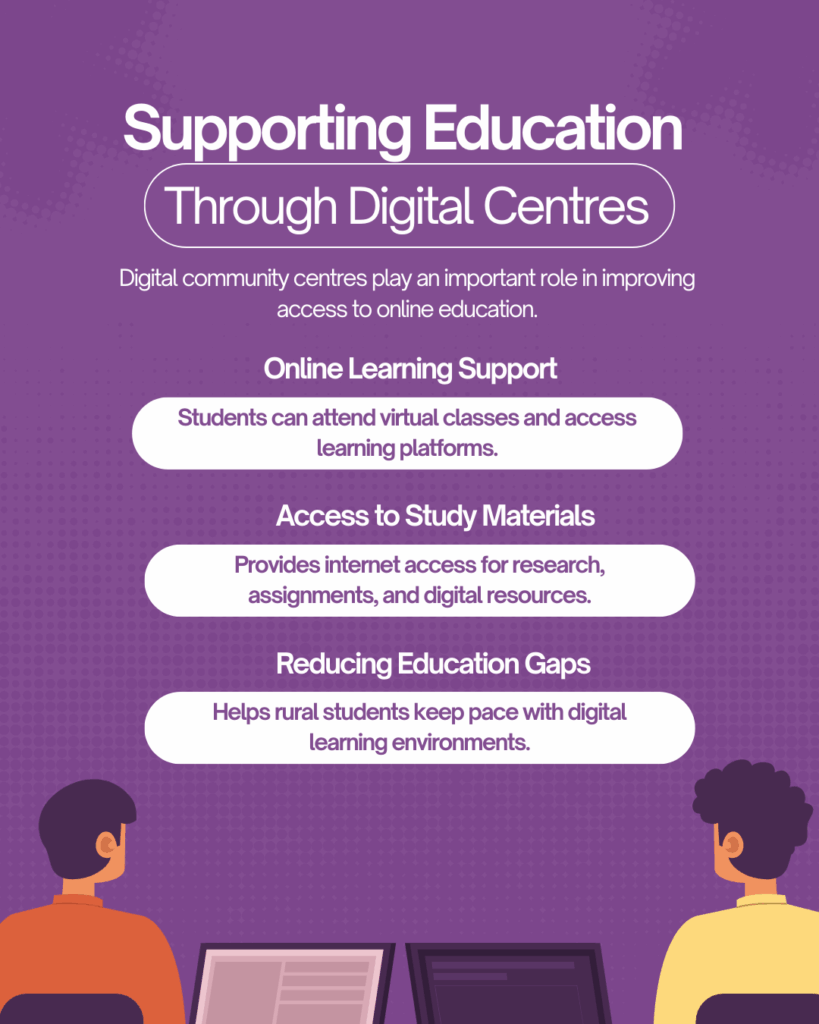
Meanwhile, a Chinese study on rural digital literacy underscores that the critical factor is not just internet access but how it is used, higher-literacy counties leveraged functional apps for finance and productivity, while lower-literacy ones defaulted to entertainment, reinforcing the need for purposeful digital engagement in Sarawak.
This imperative is further echoed by Japan and Germany, both of which emphasize “future literacy” where the ability to understand and shape technology through industry-academia-government collaboration and mobile learning labs, a crucial capacity as Sarawak aspires to become a technology creator rather than just a consumer.
Yet, expansion must be tempered with caution; Pakistan’s rapid connectivity growth brought millions online but also exposed them to misinformation, fraud, and cultural erosion, demonstrating that infrastructure must be paired with comprehensive digital literacy for safe usage.
Looking at the evolution of digital spaces, Spain’s Vuela Points Network in Andalusia shows how community centres can transform from basic access points into advanced hubs with teleworking areas and fabrication labs, a clear pathway for Sarawak’s NADI centres.
Similarly, Italy’s use of 5G hybrid networks for smart agriculture learning hubs illustrates how advanced connectivity can be leveraged for targeted economic development in key sectors like agriculture.
On a systemic level, South Africa’s UNDP framework advocates for treating connectivity as a public utility and scaling pilot projects into interoperable, secure platforms that deliver essential services and economic opportunities.
Ultimately, as the diverse experiences of Latin America from Argentina to Cuba demonstrate, there is no single model for digital inclusion; the most effective approaches are tailored to local political, economic, and social contexts.
For Sarawak, this means its current hybrid model of state investment in infrastructure combined with private operational management is a sound foundation, but one that must continue to evolve by integrating these varied global lessons to ensure its digital future is both inclusive and transformative.
Sarawak’s digital strategy has made notable strides in infrastructure, yet the success of its next phase hinges on addressing non-infrastructural elements through a fundamental shift from merely expanding access to fostering meaningful, economically productive usage, a transition guided by specific, actionable lessons from international comparisons:
- from Indonesia, the need to prioritize connectivity quality over mere coverage;
- from Singapore, the importance of planning for AI and IoT integration into governance, building on the work of the Sarawak AI Centre;
- from Taiwan, leveraging AI-powered platforms like the Cool AI system to transform NADI centres into tools for educational enhancement;
- from China, redesigning digital literacy programs to move users from passive entertainment toward active applications in finance, healthcare, and commerce;
- from Japan and Germany, investing in “future literacy” to prepare youth not just to use technology but to understand and shape it, aligning with Sarawak’s ambitions in AI and semiconductors;
- from Pakistan, intensifying digital literacy efforts around safety, privacy, and critical thinking to mitigate risks accompanying new connectivity;
- from Spain, evolving NADI centres into advanced technology hubs for co-working, digital fabrication, and entrepreneurship;
- from Italy, using advanced connectivity to support targeted sectors like agriculture through smart farming initiatives that benefit rural communities; and
- from South Africa, treating connectivity as a public utility while empowering communities by scaling successful pilots into interoperable, inclusive platforms.
Sarawak’s digital transformation is a story of commendable ambition and progress.
The foundations laid by NADI, SMART600, and the Sarawak AI Centre are significant.
However, the ultimate measure of success will not be the infrastructure built, but the extent to which all Sarawakians from a farmer in Belaga to a student in Kapit can meaningfully participate in and benefit from the digital economy.
The challenges of digital literacy, affordability, and a potential dual-track digital society are surmountable, but they require a deliberate shift to a human-centred approach.
By learning from global peers, Sarawak can ensure its digital future is one of shared prosperity, where technology acts as a tide that lifts all communities, preventing a deeper, more technologically entrenched divide.
The choices made today about investment, skills, and who to prioritise will shape the state’s digital landscape for generations to come.
References
Borneo Post. (2026, January 24). MSMEs must embrace digitalisation or risk being left behind, says Naroden.
Borneo Post. (2026, March 8). Sarawak’s AI journey: From ambition to execution.
BERNAMA. (2026, February 16). NADI SMART SERVICES RECORD 1.4 MILLION PARTICIPATIONS NATIONWIDE – MCMC.
BETTER FUTURE Awards. (2026, March 16). Digital Platform for Benefits, Incentives and Social Welfare Assistance (iSarawakCare).
Info Mercati Esteri. (2025, November 25). Malesia – 7 milioni per modernizzare servizi digitali del Sarawak.
Ministry of Communications. (2026, March 16). NADI Pelengkap Usaha Sarawak Beri Kemudahan Internet Kepada Rakyat.
Ministry of Communications. (2026, March 16). MCMC, SDEC Meterai Perjanjian Percepat Kesalinghubungan Digital Di Sarawak.
Sarawak Tribune. (2025, November 24). RM450 million to step up efforts to close digital divide.
See Hua Daily News. (2026, February 28). 乡区也无现金时代!罗伦沙加:砂支付普及化 砂拉越迈向数位新社会.
Statista. (2026, March 5). Infographic: The Global 5G Divide.
RRI.co.id. (2026, January 13). Internet Access Distribution is Crucial for Inclusive Digital Education: Govt.
Government Technology Agency, Singapore. (2026, February 6). The digital nervous system: Powering a responsive Smart Nation.
Yunlin County Government. (2026, February 2). Four Counties and Cities Sign “Cool AI” Cooperation MOU — Joining Hands to Advance Smart Education and Narrow the Urban–Rural Learning Gap.
Peking University Institute of Public Governance. (2026, January 4). National County-Level Rural Residents’ Digital Literacy Assessment Report.
Japan Telecommunications Engineering and Consulting Service. (2026, February 26). APT Senior Executive Policy Training Workshop Held.
The Nation. (2026, January 2). Internet Boom.
Magtel. (2026, February 4). Magtel strengthens its commitment to Andalusia’s digital transformation at Vuela Meeting 2026.
Las Portal. (2025, October 17). EU invests €5 million to launch 5G digital education project in Italy to promote educational equity in disadvantaged areas.
Karlsruhe Institute of Technology, Institute for Technology Assessment and Systems Analysis. (2025). Mobile Futurium – Research on discourses on the future in rural areas as part of the model project.
United Nations in South Africa. (2026, January 29). Digitisation: Sustaining livelihoods in an increasingly digital world.